
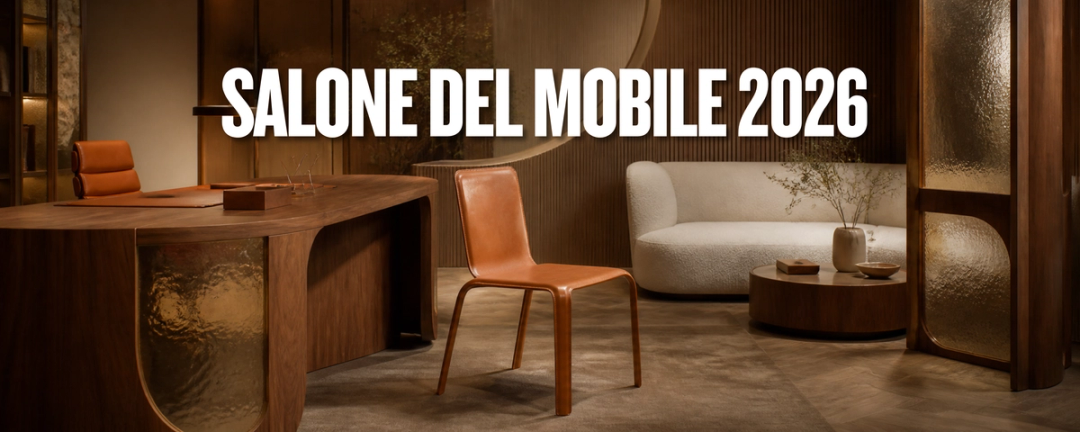
The 2026 Salone del Mobile highlighted a profound cultural shift: the way we inhabit spaces is being redefined around the human body, moving beyond the traditional centrality of the object.
Domestic space is increasingly organized around seating, which has become the symbolic and design focal point of contemporary living. Sofas, armchairs, and upholstered systems now take center stage, while traditional furniture evolves and gives way to new design logics.
Wardrobes, sideboards, and storage systems are becoming quieter, integrated, almost invisible. In their place emerges furniture designed to be seen, to create atmospheres and visual identities, to define space through perception. The home is transforming into a space to be interpreted and staged.
Within this scenario, another key trend is becoming firmly established: the widespread adoption of organic forms, both in upholstered furniture and in structural elements. Continuous curves, soft surfaces, and non-orthogonal volumes have become an integral part of the design language.
This shift is not merely aesthetic; it has technical and design implications. Organic geometries require a native three-dimensional approach. Within traditional two-dimensional drawings—plans, elevations, and sections—these forms can only be partially represented. A project maintains its coherence when it is developed and verified directly in three-dimensional space.
This edition marks a clear turning point: design is evolving from the composition of objects to the creation of continuous spatial experiences.
Living spaces are becoming increasingly perceptual and body-centered, requiring designers—and those responsible for bringing projects to life—to adopt tools, skills, and languages capable of managing this growing complexity.
In this context, the role of the company evolves from supplier to design partner, capable of translating intention into a controlled, buildable, and durable reality. This role is expressed through the ability to give structure to a complex system, where every element finds its place, its relationship, and its operational purpose throughout the entire process.
This is where technical expertise creates value: making complexity understandable, transforming a vision into a buildable sequence, and maintaining a clear direction as the project takes shape. It is within this space that PAD PROJECT and MAT SISTEM contribute, supporting the transition from concept to realization and creating continuity between what is imagined and what is ultimately produced.
Beauty, then, emerges as the natural consequence of what works.
Filippo Losacco, Architect
Architecture Manager – PAD PROJECT


