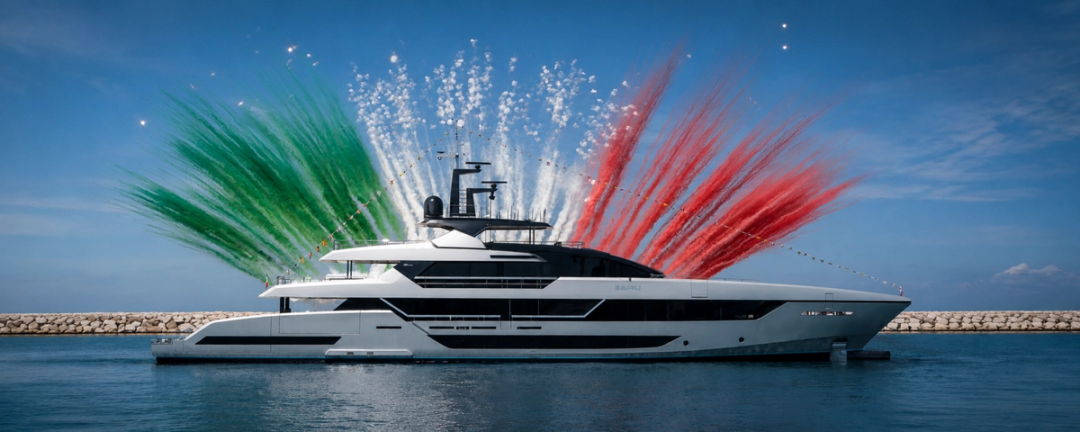
The presentation of the Riva 54Metri at Borgo Santandrea, during the “Midsummer Dream” event, brought a new flagship into the spotlight: the largest model ever built by the Riva brand, a project that marks a significant step in the history of the shipyard and within the panorama of large-scale Italian yachting.
For PAD PROJECT, the work on this unit represented a significant assignment in terms of scale, complexity and technical responsibility. Our intervention focused on the yacht’s interiors, within a process that required coordination, technical interpretation of the spaces, attention to materials and continuity between design, the joineries involved and support to the shipyard.
Working on the interiors of a yacht of this size means dealing with an articulated system, in which each space must be considered according to its function, its relationship with the adjacent areas and its overall coherence.
In a semi-serial project such as the Riva 54Metri, the first unit takes on a particularly significant role: it is the point where design, technical and operational choices find their first concrete synthesis. Every piece of information must be developed with precision, as it becomes a reference for the development and for the subsequent phases.
The peculiarity of the interiors also lies in the presence of different materials, called upon to coexist within the same design language. Surfaces, coverings, finishes, components and details must interact with balance, maintaining aesthetic continuity and technical feasibility. In this transition, the work of engineering does more than translate a drawing: it makes a complex system manageable.
PAD PROJECT contributed to the technical development of the interiors through co-engineering activities, the development of net spaces, architectural drawings and electric plans, shop drawing analysis, supervision of the joineries involved and support to the shipyard.
The PAD side of the project was led by Cecilia Cornettone, PAD PM for co-engineering, who followed the technical development of the yacht’s interiors, coordinating information, checks and operational steps. Her work was part of a broad context, where each space required attention both to the general configuration and to the precision of detail.
The project also benefited from the technical contribution of our design PM, Michael Giombani, a reference figure in the development process and in the technical interpretation of the solutions. His contribution helped build a coherent vision between the design approach, operational requirements and the complexity of the spaces.
Subsequently, the Crew area saw the direct contribution of Giorgio Candiracci, PAD PM, who followed its design. This is a fundamental area in onboard life, often less visible than guest spaces but decisive for the yacht’s daily operation. Here, efficiency, space distribution, accessibility and technical clarity become essential elements.
The industrialisation linked to the construction drawings of the Crew area was handled by Martina Soma, now also PAD PM, who contributed to transforming design information into technical documentation useful for the production phases.
The value of this project does not only concern the activities carried out, but also the people involved. Cecilia Cornettone, Michael Giombani, Giorgio Candiracci and Martina Soma are now PAD Project Managers: figures who, with different skills and specific responsibilities, reflect the growth of an internal method built over time.
On the Riva 54Metri, this experience was applied transversally. Each contribution worked on a different level of the project: from the overall reading of the interiors to the design of specific areas, from the verification of drawings to the dialogue with the joineries, through to technical support for the shipyard.
In projects of this scale, the team becomes a system of continuity. Information must move from one phase to the next without losing precision. Choices must remain legible. Details must be verifiable. Aesthetic requirements must find a technically sustainable translation for those who produce, assemble and install.
This is where PAD’s experience takes on value: in the ability to hold together different roles, skills and responsibilities, building a shared language between design, production and onboard installation.
The development of the Riva 54Metri interiors required an articulated technical process, made up of drawings, checks and continuous exchanges. Net spaces, architectural drawings, electric plans and shop drawing analyses are different tools, but they all contribute to the same objective: making each space legible, coordinated and ready for the following phases.
The supervision of the joineries and support to the shipyard completed this process, taking PAD’s contribution beyond the production of documentation. In a large-scale project, technical drawing takes on value when it becomes an operational tool, allowing the figures involved to work with greater clarity and supporting continuity between what is developed in the technical office and what takes shape onboard.
Each interior space is the result of many coordinated decisions. Behind the final perception of harmony lies a structure made of checks, relationships between materials, interfaces, constraints, revisions and shared responsibilities, within the context of a brand such as Riva, internationally recognised for its prestige and excellence.


